Music exposure reduces anxiety- and depression-like behavior in rodents: a systematic review and multilevel meta-analysis
  • OSF
  • Paper
  1. Effect size calculation
  • Online supplementary
  • Effect size calculation
  • Overall effects
  • Uni-moderators
  • Publication bias
  • Leave-one-out
  • Code for figures
  • Alluvial plot

Table of contents

  • lnRR
  • lnVR
  • lnCVR
  • Functions and computation

Effect size calculation

  • Show All Code
  • Hide All Code

  • View Source
pacman::p_load(
               DT,
               dtplyr,
               here, 
               knitr,
               tidyverse,
               patchwork,
               metafor,
               orchaRd, kableExtra
               )

lnRR

This section estimates the log response ratio (lnRR), which quantifies whether music exposure changes the average level of a behavioral outcome relative to controls.

The lnRR is defined as: \[ \begin{equation} \label{eq:lnRR} \ln RR = \ln\left(\frac{M_T}{M_C}\right) + \frac{1}{2} \left( \frac{SD_T^2}{N_T M_T^2} - \frac{SD_C^2}{N_C M_C^2} \right), \end{equation} \] where \(M_T\) and \(M_C\) denote the sample means, \(SD_T\) and \(SD_C\) the sample standard deviations, and \(N_T\) and \(N_C\) the sample sizes of the music-exposed (treatment) and control groups, respectively.

Negative lnRR values indicate reductions in anxiety- or depression-like behavior under music exposure (after directional harmonization). Specifically, we harmonize outcome direction using the variable Higher_better such that lnRR is multiplied by \(−1\) when higher values represent improved outcomes (e.g., more exploration or less immobility).

lnVR

Here we estimate the log variability ratio (lnVR), which quantifies whether music exposure changes the dispersion (standard deviation) of behavioral outcomes relative to controls.

lnVR is defined as \[ \ln VR = \ln\left(\frac{SD_T}{SD_C}\right) + \frac{1}{2}\left(\frac{1}{N_T-1}-\frac{1}{N_C-1}\right) \] where \(SD\) is the standard deviation and \(N\) is the sample size for treatment (\(T\)) and control (\(C\)) groups.

A positive lnVR indicates higher variability under music exposure (less consistent responses), whereas a negative lnVR indicates lower variability (more consistent responses).

lnCVR

Finally, we estimate the log coefficient of variation ratio (lnCVR). Whereas lnVR compares standard deviations directly, lnCVR compares relative variability, thereby accounting for differences in group means. This is useful when variability is expected to scale with the mean.

lnCVR is defined as

\[ \ln \text{CVR} = \ln \left( \frac{CV_T}{CV_C} \right) + \frac{1}{2} \left( \frac{1}{n_T - 1} - \frac{1}{n_C - 1} \right) - \frac{1}{2} \left( \frac{s_T^2}{n_T M_T^2} - \frac{s_C^2}{n_C M_C^2} \right) \]

where \(M\), \(SD\), amd \(n\) are the sample mean, standard deviation, and sample size for treatment (\(T\)) and control (\(C\)) groups, respectively. \(\text{with} \quad CV = \frac{SD}{M}\)

A positive lnCVR indicates higher relative variability (higher \(CV\)) under music exposure, whereas a negative lnCVR indicates lower relative variability (lower \(CV\)).

Functions and computation

NoteShared workflow details for effect-size functions

All three effect-size functions (calculate_lnRR(), calculate_lnVR(), calculate_lnCVR()) follow the same general preprocessing and design-handling logic to ensure numerical stability and consistent treatment of study designs.

Data-type handling

  • Outcomes are categorized via Data_type.
  • Proportional outcomes (Data_type == "percentage") are treated separately for lnRR (variance-stabilizing transformation), and excluded from lnVR and lnCVR because bounded scales induce a mechanical mean–variance relationship that complicates biological interpretation of variability metrics.

Boundary corrections and numerical safeguards

To prevent undefined operations (e.g., log(0) or division by zero), the functions apply small boundary corrections when needed:

  • means reported as exactly 0 are shifted to a small positive constant (e.g., 0.005),

  • standard deviations reported as 0 are shifted to small positive constants (e.g., 0.01 / 0.05).

These adjustments are strictly pragmatic and affect only edge cases where effect sizes would otherwise be undefined.

Standard deviation imputation (when required)

When studies report standard errors but not standard deviations, SDs are derived using: \[ \text{SD} = \text{SE} \times \sqrt{N} \] This imputation is performed during data preprocessing (before effect size computation) so that all effect-size functions operate on complete SD fields.

Independent vs dependent comparisons

Each function accounts for whether treatment and control groups are independent (different animals) or dependent (paired / repeated measures), using Comparison_structure:

  • Independent: standard two-group estimators are used.

  • Dependent: correlated-sample estimators are used, and sampling variances include the covariance term implied by within-subject correlation.

When correlation is not reported, we assume a moderate within-subject correlation of \(r = 0.5\), consistent across lnRR, lnVR, and lnCVR, to enable variance estimation for paired designs.

Direction harmonization

Direction harmonization (multiplying by \(−1\) using Higher_better) is applied only to lnRR, because it represents a mean shift with a natural “beneficial vs harmful” polarity after standardizing outcome direction. Variability metrics (lnVR and lnCVR) are interpreted directly (positive = more variable under music; negative = less variable), since dispersion is not inherently “good” or “bad” across outcomes.

db <- readr::read_csv(here("..","data","db251124.csv")) %>%
  mutate(
    across(c(C_n, Ex_n, C_mean, Ex_mean, C_SE, Ex_SE, C_SD, Ex_SD), as.numeric),
    Data_type = tolower(as.character(Data_type)),
    Comparison_structure = as.character(Comparison_structure),
    Higher_better = as.character(Higher_better)
  ) %>%
  # Impute SD when missing but SE available: SD = SE * sqrt(n)
  mutate(
    C_SD  = ifelse(is.na(C_SD)  & !is.na(C_SE)  & !is.na(C_n),  C_SE  * sqrt(C_n),  C_SD),
    Ex_SD = ifelse(is.na(Ex_SD) & !is.na(Ex_SE) & !is.na(Ex_n), Ex_SE * sqrt(Ex_n), Ex_SD)
  ) %>%
  # Helpful unique cohort identifier (optional)
  mutate(Cohort_ID = paste(Study_ID, "Ex-ID", sep = "_"))
NoteHow to handle zeros in means and SDs?

Some studies report means or standard deviations equal to zero (often due to rounding, reporting limits, or zero-inflated measures). Because our effect sizes involve log ratios (e.g., lnRR, lnVR, lnCVR), exact zeros can produce undefined values (e.g., log(0) or division by zero). To avoid dropping these effect sizes, we apply a small continuity correction that is conservative and grounded in the observed data.

This callout contains (i) a continuity-correction helper used during effect-size calculation and (ii) a small audit routine that verifies exactly which rows were modified.

  1. min_pos(): find the smallest non-zero value. This is used to define a “biologically realistic” continuity correction based on observed data rather than an arbitrary constant.

  2. apply_continuity_within_group(): continuity correction within outcome strata, separately for each group (control or experimental). This function prevents undefined computations (e.g., log(0) or division by 0)

Step-by-step

  1. Standardize types

Converts Data_type to lowercase.

Coerces C_mean, Ex_mean, C_SD, and Ex_SD to numeric to ensure reliable comparisons to zero

  1. Define “local” minima within strata

The dataset is grouped by strata (default: Assay_type × Measurment_variable × Data_type).

Within each stratum, it computes:

min_C_mean_pos: smallest positive control mean

min_Ex_mean_pos: smallest positive experimental mean

These are computed separately for control and experimental groups

  1. Compute continuity constants (epsilons)

For each stratum:

eps_C_mean = mult × min_C_mean_pos

eps_Ex_mean = mult × min_Ex_mean_pos

With mult = \(0.9\), the replacement value is slightly smaller than the smallest observed non-zero value in that stratum, keeping it within a plausible range.

  1. Apply corrections

If C_mean == 0, replace with eps_C_mean

If Ex_mean == 0, replace with eps_Ex_mean This ensures means are non-zero where required

Code
min_pos <- function(x) {
  x <- x[is.finite(x) & !is.na(x) & x > 0]
  if (length(x) == 0) return(NA_real_)
  min(x)
}

apply_continuity_within_group <- function(dt,
                                          strata = c("Assay_type", "Measurment_variable", "Data_type"),
                                          mult = 0.9) {

  dt <- dt %>%
    mutate(
      Data_type = tolower(as.character(Data_type)),
      across(c(C_mean, Ex_mean, C_SD, Ex_SD), ~as.numeric(as.character(.)))
    )

  mins <- dt %>%
    group_by(across(all_of(strata))) %>%
    summarise(
      min_C_mean_pos  = min_pos(C_mean),
      min_Ex_mean_pos = min_pos(Ex_mean),
      .groups = "drop"
    )

  g_C_mean  <- min_pos(dt$C_mean)
  g_Ex_mean <- min_pos(dt$Ex_mean)

  dt %>%
    left_join(mins, by = strata) %>%
    mutate(
      eps_C_mean  = mult * coalesce(min_C_mean_pos,  g_C_mean),
      eps_Ex_mean = mult * coalesce(min_Ex_mean_pos, g_Ex_mean),

      # Mean correction (within-group)
      C_mean  = ifelse(!is.na(C_mean)  & C_mean == 0,  eps_C_mean,  C_mean),
      Ex_mean = ifelse(!is.na(Ex_mean) & Ex_mean == 0, eps_Ex_mean, Ex_mean),

      # SD rule if SD == 0, set to 0.05
      C_SD  = ifelse(!is.na(C_SD)  & C_SD == 0,  0.05, C_SD),
      Ex_SD = ifelse(!is.na(Ex_SD) & Ex_SD == 0, 0.05, Ex_SD)
    ) %>%
    select(-min_C_mean_pos, -min_Ex_mean_pos, -eps_C_mean, -eps_Ex_mean)
}
  1. Audit chunk: verify exactly which rows changed
Code
db_before <- db %>%
  mutate(
    Data_type = tolower(as.character(Data_type)),
    across(c(C_mean, Ex_mean, C_SD, Ex_SD), ~as.numeric(as.character(.)))
  ) %>%
  select(
    ES_ID, Study_ID, Cohort_ID, Assay_type, Measurment_variable, Data_type,
    C_mean, Ex_mean, C_SD, Ex_SD
  )

db_after <- apply_continuity_within_group(
  db_before,
  strata = c("Assay_type", "Measurment_variable", "Data_type"),
  mult = 0.9
) %>%
  select(ES_ID, C_mean, Ex_mean, C_SD, Ex_SD) %>%
  rename_with(~paste0(.x, "_new"), -ES_ID)

diff <- db_before %>%
  left_join(db_after, by = "ES_ID") %>%
  mutate(
    ch_C_mean  = (C_mean  != C_mean_new)  & !(is.na(C_mean)  & is.na(C_mean_new)),
    ch_Ex_mean = (Ex_mean != Ex_mean_new) & !(is.na(Ex_mean) & is.na(Ex_mean_new)),
    ch_C_SD    = (C_SD    != C_SD_new)    & !(is.na(C_SD)    & is.na(C_SD_new)),
    ch_Ex_SD   = (Ex_SD   != Ex_SD_new)   & !(is.na(Ex_SD)   & is.na(Ex_SD_new)),
    any_change = ch_C_mean | ch_Ex_mean | ch_C_SD | ch_Ex_SD
  )

# ---- Table 1: Summary counts  ----
tab_counts <- diff %>%
  summarise(
    `Total effect sizes` = n(),
    `Any change` = sum(any_change),
    `Control mean changed` = sum(ch_C_mean),
    `Experimental mean changed` = sum(ch_Ex_mean),
    `Control SD changed` = sum(ch_C_SD),
    `Experimental SD changed` = sum(ch_Ex_SD)
  )

kable(tab_counts, digits = 0, caption = "Audit summary: number of effect sizes modified by the continuity correction.") %>%
  kable_styling(full_width = FALSE, bootstrap_options = c("striped", "condensed"))
Audit summary: number of effect sizes modified by the continuity correction.
Total effect sizes Any change Control mean changed Experimental mean changed Control SD changed Experimental SD changed
298 5 3 0 5 0
Code
# ---- Table 2: Row-level details (only rows that changed) ----
tab_changes <- diff %>%
  filter(any_change) %>%
  arrange(Study_ID, ES_ID) %>%
  transmute(
    Study_ID, ES_ID, Cohort_ID, Assay_type, Measurment_variable, Data_type,

    `C_mean (old)` = C_mean, `C_mean (new)` = C_mean_new,
    `C_SD (old)`   = C_SD,   `C_SD (new)`   = C_SD_new,

    `Ex_mean (old)` = Ex_mean, `Ex_mean (new)` = Ex_mean_new,
    `Ex_SD (old)`   = Ex_SD,   `Ex_SD (new)`   = Ex_SD_new
  )

kable(
  tab_changes,
  digits = 3,
  caption = "Audit details: effect sizes where any value was modified (old vs new)."
) %>%
  kable_styling(full_width = TRUE, bootstrap_options = c("striped", "condensed")) %>%
  scroll_box(width = "100%", height = "350px")
Audit details: effect sizes where any value was modified (old vs new).
Study_ID ES_ID Cohort_ID Assay_type Measurment_variable Data_type C_mean (old) C_mean (new) C_SD (old) C_SD (new) Ex_mean (old) Ex_mean (new) Ex_SD (old) Ex_SD (new)
Krishnamurthy_2025_INDIANJTRADITKNOW es001 Krishnamurthy_2025_INDIANJTRADITKNOW_Ex-ID Elevated Plus Maze Open arm entries count 0.000 2.710 0 0.05 2.002 2.002 1.051 1.051
Krishnamurthy_2025_INDIANJTRADITKNOW es003 Krishnamurthy_2025_INDIANJTRADITKNOW_Ex-ID Elevated Plus Maze Time in open arms time 0.000 2.467 0 0.05 31.378 31.378 23.443 23.443
Krishnamurthy_2025_INDIANJTRADITKNOW es005 Krishnamurthy_2025_INDIANJTRADITKNOW_Ex-ID Elevated Plus Maze Head dips count 0.000 5.099 0 0.05 3.256 3.256 1.305 1.305
Ren_2024_ASEAN es174 Ren_2024_ASEAN_Ex-ID Elevated Plus Maze Distance open arm distance 18.237 18.237 0 0.05 194.529 194.529 221.071 221.071
Ren_2024_ASEAN es175 Ren_2024_ASEAN_Ex-ID Elevated Plus Maze Distance open arm distance 18.237 18.237 0 0.05 489.362 489.362 480.589 480.589
  • lnRR
  • lnVR
  • lnCVR
Code
calculate_lnRR <- function(dt) {

  ## 1. Standardize Data_type first (needed for filtering)
  dt <- dt %>%
    mutate(Data_type = tolower(as.character(Data_type)))

  ## 2. Apply continuity correction ONLY to non-percentage data
  dt_nonperc <- dt %>%
    filter(!Data_type %in% c("percentage")) %>%
    apply_continuity_within_group(
      strata = c("Assay_type", "Measurment_variable", "Data_type"),
      mult = 0.9
    )

  ## 3. Handle percentage data separately (bounded safeguards)
  dt_perc <- dt %>%
    filter(Data_type %in% c("percentage")) %>%
    mutate(
      # Guard against exact 0 and 100 on 0–100 scales (symmetrically)
      C_mean  = ifelse(C_mean  == 0,   0.5,  C_mean),
      Ex_mean = ifelse(Ex_mean == 0,   0.5,  Ex_mean),
      C_mean  = ifelse(C_mean  == 100, 99.5, C_mean),
      Ex_mean = ifelse(Ex_mean == 100, 99.5, Ex_mean),

      # Guard against SD = 0 for bounded outcomes (symmetrically)
      C_SD  = ifelse(C_SD  == 0, 0.5, C_SD),
      Ex_SD = ifelse(Ex_SD == 0, 0.5, Ex_SD)
    )

  ## 4. Recombine (preserve original ordering if ES_ID exists)
  dt <- bind_rows(dt_nonperc, dt_perc) %>%
    { if ("ES_ID" %in% names(.)) arrange(., ES_ID) else . }

  ## 5. Setup
  dt1 <- dt %>%
    mutate(
      lnRR = NA_real_,
      lnRR_var = NA_real_
    )

  asin_trans <- function(proportion) asin(sqrt(proportion))

  ## 6. Calculation Loop
  for (i in seq_len(nrow(dt1))) {

    Ex_n <- dt1$Ex_n[i]
    C_n <- dt1$C_n[i]
    Ex_mean <- dt1$Ex_mean[i]
    C_mean <- dt1$C_mean[i]
    Ex_SD <- dt1$Ex_SD[i]
    C_SD <- dt1$C_SD[i]
    Data_type <- dt1$Data_type[i]
    Comparison_structure <- dt1$Comparison_structure[i]
    Higher_better <- dt1$Higher_better[i]

    # --- A. Continuous Data ---
    if (Data_type %in% c("time", "distance", "count", "latency", "index")) {

      if (Comparison_structure == "Independent") {
        effect <- metafor::escalc(
          measure = "ROM",
          n1i = Ex_n, n2i = C_n,
          m1i = Ex_mean, m2i = C_mean,
          sd1i = Ex_SD, sd2i = C_SD,
          var.names = c("lnRR", "lnRR_var")
        )
      } else if (Comparison_structure == "Dependent") {
        effect <- metafor::escalc(
          measure = "ROMC",
          ni = (Ex_n + C_n) / 2,
          m1i = Ex_mean, m2i = C_mean,
          sd1i = Ex_SD, sd2i = C_SD,
          ri = 0.5,
          var.names = c("lnRR", "lnRR_var")
        )
      } else {
        next
      }

      dt1$lnRR[i] <- effect$lnRR
      dt1$lnRR_var[i] <- effect$lnRR_var

      # Direction harmonization (keep as you had it)
      if (Higher_better == "Yes") dt1$lnRR[i] <- -dt1$lnRR[i]
    }

    # --- B. Proportion Data (Percentage) ---
    else if (Data_type %in% c("percentage")) {

      # Conditional rescaling (0–100 -> 0–1)
      if (max(c(Ex_mean, C_mean), na.rm = TRUE) > 1) {
        Ex_mean <- Ex_mean / 100
        C_mean  <- C_mean  / 100
        Ex_SD   <- Ex_SD   / 100
        C_SD    <- C_SD    / 100
      }

      # Transform SDs
      Ex_SD_trans <- sqrt(Ex_SD^2 / (4 * Ex_mean * (1 - Ex_mean)))
      C_SD_trans  <- sqrt(C_SD^2  / (4 * C_mean  * (1 - C_mean)))

      # Transform means
      Ex_mean_trans <- asin_trans(Ex_mean)
      C_mean_trans  <- asin_trans(C_mean)

      # lnRR
      lnRR_pro_calc <- log(Ex_mean_trans / C_mean_trans)

      # Sampling variance
      V_Ex <- (Ex_SD_trans)^2 * (1 / (Ex_mean_trans^2 * Ex_n))
      V_C  <- (C_SD_trans)^2  * (1 / (C_mean_trans^2  * C_n))

      if (Comparison_structure == "Independent") {
        lnRR_var_pro <- V_Ex + V_C
      } else if (Comparison_structure == "Dependent") {
        lnRR_var_pro <- V_Ex + V_C - 2 * 0.5 * sqrt(V_Ex) * sqrt(V_C)
      } else {
        next
      }

      if (Higher_better == "Yes") lnRR_pro_calc <- -lnRR_pro_calc

      dt1$lnRR[i] <- lnRR_pro_calc
      dt1$lnRR_var[i] <- lnRR_var_pro
    }
  }

  return(dt1)
}
db_lnRR <- calculate_lnRR(db)
Code
calculate_lnVR <- function(dt) {

  ## 1. Filter out Proportional Data
  dt <- dt %>%
    mutate(Data_type = tolower(as.character(Data_type))) %>% 
    filter(!Data_type %in% c("percentage")) 
  
  if (nrow(dt) == 0) {
    message("No non-percentage data remaining for lnVR calculation.")
    return(dt)
  }

  ## 2. Data Cleaning and Imputation
  dt <- apply_continuity_within_group(dt,
  strata = c("Assay_type", "Measurment_variable", "Data_type"),
  mult = 0.9
)
  ## 3. Setup
  dt$lnVR <- NA_real_
  dt$lnVR_var <- NA_real_

  ## 4. Calculation Loop
  for (i in seq_len(nrow(dt))) {
    
    # Extract variables
    Ex_n <- dt$Ex_n[i]
    C_n <- dt$C_n[i]
    Ex_SD <- dt$Ex_SD[i]
    C_SD <- dt$C_SD[i]
    Data_type <- dt$Data_type[i]
    Comparison_structure <- dt$Comparison_structure[i]
    
    # --- Continuous Data ---
    if (Data_type %in% c("time", "distance", "count", "latency", "index")) {
      
      # A. INDEPENDENT GROUPS
      if (Comparison_structure == "Independent") {
        
        # measure = "VR" (Variability Ratio for independent groups)
        # Requires n1i, n2i, sd1i, sd2i
        effect <- metafor::escalc(
          measure = "VR", 
          n1i = Ex_n, n2i = C_n,
          sd1i = Ex_SD, sd2i = C_SD,
          var.names = c("lnVR", "lnVR_var")
        )
        
      # B. DEPENDENT GROUPS
      } else if (Comparison_structure == "Dependent") {
        
        # measure = "VRC" (Variability Ratio for Correlated/Dependent groups)
        # Requires 'ni' (sample size of pairs) and 'ri' (correlation)
        # We assume ri = 0.5 (consistent with the lnRR approach)
        effect <- metafor::escalc(
          measure = "VRC", 
          ni = (Ex_n + C_n) / 2, # Use average N for the pair
          sd1i = Ex_SD, sd2i = C_SD,
          ri = 0.5, 
          var.names = c("lnVR", "lnVR_var")
        )
      }
      
      # Assign results
      dt$lnVR[i] <- effect$lnVR
      dt$lnVR_var[i] <- effect$lnVR_var
      
 
    }
  }
  
  return(dt)
}
db_lnVR <- calculate_lnVR(db)
Code
calculate_lnCVR <- function(dt) {

  ## 1. Filter out Proportional Data (bounded outcomes)
  dt <- dt %>%
    mutate(Data_type = tolower(as.character(Data_type))) %>% 
    filter(!Data_type %in% c("percentage")) 
  
  if (nrow(dt) == 0) {
    message("No non-percentage data remaining for lnCVR calculation.")
    return(dt)
  }

  ## 2. Data Cleaning and Safeguards
  dt <- apply_continuity_within_group(
  dt,
  strata = c("Assay_type", "Measurment_variable", "Data_type"),
  mult = 0.9
)

  ## 3. Setup
  dt1 <- dt %>%
    mutate(
      lnCVR = NA_real_,
      lnCVR_var = NA_real_
    )

  ## 4. Calculation Loop
  for (i in seq_len(nrow(dt1))) {

    # Extract variables
    Ex_n <- dt1$Ex_n[i]
    C_n  <- dt1$C_n[i]
    Ex_mean <- dt1$Ex_mean[i]
    C_mean  <- dt1$C_mean[i]
    Ex_SD <- dt1$Ex_SD[i]
    C_SD  <- dt1$C_SD[i]
    Data_type <- dt1$Data_type[i]
    Comparison_structure <- dt1$Comparison_structure[i]

    # --- Continuous Data ---
    if (Data_type %in% c("time", "distance", "count", "latency", "index")) {

      # A. INDEPENDENT GROUPS
      if (Comparison_structure == "Independent") {

        # measure = "CVR" (Coefficient of Variation Ratio; independent groups)
        effect <- metafor::escalc(
          measure = "CVR",
          n1i = Ex_n, n2i = C_n,
          m1i = Ex_mean, m2i = C_mean,
          sd1i = Ex_SD, sd2i = C_SD,
          var.names = c("lnCVR", "lnCVR_var")
        )

      # B. DEPENDENT GROUPS
      } else if (Comparison_structure == "Dependent") {

        # measure = "CVRC" (CV ratio for correlated/paired groups)
        # assumes ri = 0.5 for within-subject correlation
        effect <- metafor::escalc(
          measure = "CVRC",
          ni = (Ex_n + C_n) / 2,   # average N for the pair
          m1i = Ex_mean, m2i = C_mean,
          sd1i = Ex_SD, sd2i = C_SD,
          ri = 0.5,
          var.names = c("lnCVR", "lnCVR_var")
        )
      } else {
        next
      }

      # Assign results
      dt1$lnCVR[i] <- effect$lnCVR
      dt1$lnCVR_var[i] <- effect$lnCVR_var
    }
  }

  return(dt1)
}
db_lnCVR <- calculate_lnCVR(db)

Save the analysis-ready effect size table

db_es <- db_lnRR %>%
  left_join(
    db_lnVR %>% select(ES_ID, lnVR, lnVR_var),
    by = "ES_ID"
  ) %>%
  left_join(
    db_lnCVR %>% select(ES_ID, lnCVR, lnCVR_var),
    by = "ES_ID"
  )
readr::write_csv(db_es, here("..","data","db_effect_sizes.csv"))

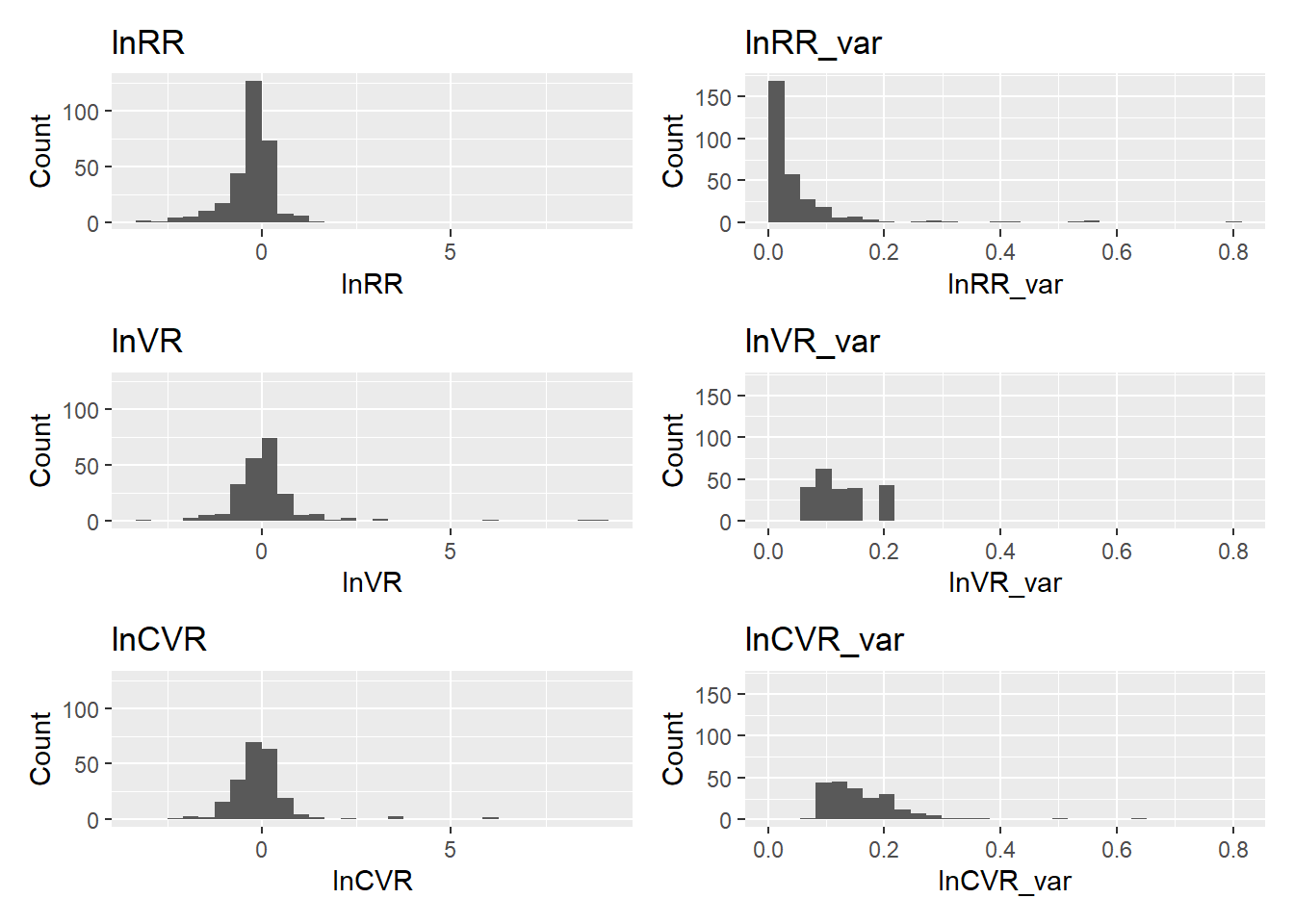
We load the dataset for visuallization

db_es <- readr::read_csv(here("..","data","db_effect_sizes.csv")) %>%
  mutate(Data_type = tolower(as.character(Data_type)))
Code
# --- 1) Prepare vectors (drop NAs) ---
x_eff <- db_es %>% select(lnRR, lnVR, lnCVR) %>% unlist(use.names = FALSE)
x_eff <- x_eff[is.finite(x_eff)]

x_var <- db_es %>% select(lnRR_var, lnVR_var, lnCVR_var) %>% unlist(use.names = FALSE)
x_var <- x_var[is.finite(x_var)]

# --- 2) Shared x-limits + binwidths (30 bins across the pooled range) ---
xlim_eff <- range(x_eff)
xlim_var <- range(x_var)

bw_eff <- diff(xlim_eff) / 30
bw_var <- diff(xlim_var) / 30

# --- 3) Shared y-limits (max bin count across variables, using same breaks) ---
breaks_eff <- seq(xlim_eff[1], xlim_eff[2], by = bw_eff)
breaks_var <- seq(xlim_var[1], xlim_var[2], by = bw_var)

ymax_eff <- max(
  hist(db_es$lnRR,  breaks = breaks_eff, plot = FALSE)$counts,
  hist(db_es$lnVR,  breaks = breaks_eff, plot = FALSE)$counts,
  hist(db_es$lnCVR, breaks = breaks_eff, plot = FALSE)$counts,
  na.rm = TRUE
)

ymax_var <- max(
  hist(db_es$lnRR_var,  breaks = breaks_var, plot = FALSE)$counts,
  hist(db_es$lnVR_var,  breaks = breaks_var, plot = FALSE)$counts,
  hist(db_es$lnCVR_var, breaks = breaks_var, plot = FALSE)$counts,
  na.rm = TRUE
)

# --- 4) Plot helper (standardized x/y) ---
plot_hist <- function(data, var, title, bw, xlim, ymax) {
  ggplot(data, aes(x = {{ var }})) +
    geom_histogram(binwidth = bw, boundary = xlim[1], closed = "left") +
    coord_cartesian(xlim = xlim, ylim = c(0, ymax)) +
    labs(title = title, x = title, y = "Count")
}

# --- 5) Effect-size histograms (shared axes) ---
p_lnRR   <- plot_hist(db_es, lnRR,   "lnRR",   bw_eff, xlim_eff, ymax_eff)
p_lnVR   <- plot_hist(db_es, lnVR,   "lnVR",   bw_eff, xlim_eff, ymax_eff)
p_lnCVR  <- plot_hist(db_es, lnCVR,  "lnCVR",  bw_eff, xlim_eff, ymax_eff)

# --- 6) Sampling-variance histograms (shared axes) ---
p_lnRR_v  <- plot_hist(db_es, lnRR_var,  "lnRR_var",  bw_var, xlim_var, ymax_var)
p_lnVR_v  <- plot_hist(db_es, lnVR_var,  "lnVR_var",  bw_var, xlim_var, ymax_var)
p_lnCVR_v <- plot_hist(db_es, lnCVR_var, "lnCVR_var", bw_var, xlim_var, ymax_var)

# --- 7) Arrange (3 rows × 2 columns) ---
(p_lnRR | p_lnRR_v) /
(p_lnVR | p_lnVR_v) /
(p_lnCVR | p_lnCVR_v)
Online supplementary
Overall effects
Source Code
---
title: "Effect size calculation"
---
```{r}
#| label: setup
#| include: true
pacman::p_load(
               DT,
               dtplyr,
               here, 
               knitr,
               tidyverse,
               patchwork,
               metafor,
               orchaRd, kableExtra
               )
```


# lnRR

This section estimates the log response ratio (lnRR), which quantifies whether music exposure changes the average level of a behavioral outcome relative to controls.

::: card
The lnRR is defined as: $$
\begin{equation} \label{eq:lnRR}
\ln RR =
\ln\left(\frac{M_T}{M_C}\right)
+
\frac{1}{2}
\left(
\frac{SD_T^2}{N_T M_T^2}
-
\frac{SD_C^2}{N_C M_C^2}
\right),
\end{equation}
$$ where $M_T$ and $M_C$ denote the sample means, $SD_T$ and $SD_C$ the sample standard deviations, and $N_T$ and $N_C$ the sample sizes of the music-exposed (treatment) and control groups, respectively.
:::


Negative lnRR values indicate reductions in anxiety- or depression-like behavior under music exposure (after directional harmonization). Specifically, we harmonize outcome direction using the variable `Higher_better` such that lnRR is multiplied by $−1$ when higher values represent improved outcomes (e.g., more exploration or less immobility).


# lnVR

Here we estimate the log variability ratio (lnVR), which quantifies whether music exposure changes the dispersion (standard deviation) of behavioral outcomes relative to controls.

::: card
lnVR is defined as
$$
\ln VR = \ln\left(\frac{SD_T}{SD_C}\right) + \frac{1}{2}\left(\frac{1}{N_T-1}-\frac{1}{N_C-1}\right)
$$
where $SD$ is the standard deviation and $N$ is the sample size for treatment ($T$) and control ($C$) groups.
:::

A positive lnVR indicates higher variability under music exposure (less consistent responses), whereas a negative lnVR indicates lower variability (more consistent responses).


# lnCVR

Finally, we estimate the log coefficient of variation ratio (lnCVR). Whereas lnVR compares standard deviations directly, lnCVR compares relative variability, thereby accounting for differences in group means. This is useful when variability is expected to scale with the mean.


::: card
lnCVR is defined as


$$
\ln \text{CVR} = \ln \left( \frac{CV_T}{CV_C} \right) + \frac{1}{2} \left( \frac{1}{n_T - 1} - \frac{1}{n_C - 1} \right) - \frac{1}{2} \left( \frac{s_T^2}{n_T M_T^2} - \frac{s_C^2}{n_C M_C^2} \right)
$$

where $M$, $SD$, amd $n$ are the sample mean, standard deviation, and sample size for treatment ($T$) and control ($C$) groups, respectively. $\text{with} \quad CV = \frac{SD}{M}$
:::

A positive lnCVR indicates higher relative variability (higher $CV$) under music exposure, whereas a negative lnCVR indicates lower relative variability (lower $CV$). 


# Functions and computation

::: callout-note

# Shared workflow details for effect-size functions

All three effect-size functions (`calculate_lnRR()`, `calculate_lnVR()`, `calculate_lnCVR()`) follow the same general preprocessing and design-handling logic to ensure numerical stability and consistent treatment of study designs.

## Data-type handling

- Outcomes are categorized via `Data_type`.
- Proportional outcomes (`Data_type == "percentage"`) are treated separately for lnRR (variance-stabilizing transformation), and excluded from lnVR and lnCVR because bounded scales induce a mechanical mean–variance relationship that complicates biological interpretation of variability metrics.

## Boundary corrections and numerical safeguards
To prevent undefined operations (e.g., log(0) or division by zero), the functions apply small boundary corrections when needed:

- means reported as exactly 0 are shifted to a small positive constant (e.g., 0.005),

- standard deviations reported as 0 are shifted to small positive constants (e.g., 0.01 / 0.05).

These adjustments are strictly pragmatic and affect only edge cases where effect sizes would otherwise be undefined.

## Standard deviation imputation (when required)

When studies report standard errors but not standard deviations, SDs are derived using:
$$
\text{SD} = \text{SE} \times \sqrt{N}
$$
This imputation is performed during data preprocessing (before effect size computation) so that all effect-size functions operate on complete `SD` fields.


## Independent vs dependent comparisons

Each function accounts for whether treatment and control groups are independent (different animals) or dependent (paired / repeated measures), using `Comparison_structure`:

- Independent: standard two-group estimators are used.

- Dependent: correlated-sample estimators are used, and sampling variances include the covariance term implied by within-subject correlation.

When correlation is not reported, we assume a moderate within-subject correlation of $r = 0.5$, consistent across lnRR, lnVR, and lnCVR, to enable variance estimation for paired designs.

## Direction harmonization

Direction harmonization (multiplying by $−1$ using `Higher_better`) is applied only to lnRR, because it represents a mean shift with a natural “beneficial vs harmful” polarity after standardizing outcome direction. Variability metrics (lnVR and lnCVR) are interpreted directly (positive = more variable under music; negative = less variable), since dispersion is not inherently “good” or “bad” across outcomes.
:::

```{r}
#| label: load_and_preprocess_db
#| message: false
#| warning: false

db <- readr::read_csv(here("..","data","db251124.csv")) %>%
  mutate(
    across(c(C_n, Ex_n, C_mean, Ex_mean, C_SE, Ex_SE, C_SD, Ex_SD), as.numeric),
    Data_type = tolower(as.character(Data_type)),
    Comparison_structure = as.character(Comparison_structure),
    Higher_better = as.character(Higher_better)
  ) %>%
  # Impute SD when missing but SE available: SD = SE * sqrt(n)
  mutate(
    C_SD  = ifelse(is.na(C_SD)  & !is.na(C_SE)  & !is.na(C_n),  C_SE  * sqrt(C_n),  C_SD),
    Ex_SD = ifelse(is.na(Ex_SD) & !is.na(Ex_SE) & !is.na(Ex_n), Ex_SE * sqrt(Ex_n), Ex_SD)
  ) %>%
  # Helpful unique cohort identifier (optional)
  mutate(Cohort_ID = paste(Study_ID, "Ex-ID", sep = "_"))

```


::: callout-note
## How to handle zeros in means and SDs?

Some studies report means or standard deviations equal to zero (often due to rounding, reporting limits, or zero-inflated measures). Because our effect sizes involve log ratios (e.g., lnRR, lnVR, lnCVR), exact zeros can produce undefined values (e.g., log(0) or division by zero). To avoid dropping these effect sizes, we apply a small continuity correction that is conservative and grounded in the observed data.

This callout contains (i) a continuity-correction helper used during effect-size calculation and (ii) a small audit routine that verifies exactly which rows were modified.

1) `min_pos()`: find the smallest non-zero value. This is used to define a “biologically realistic” continuity correction based on observed data rather than an arbitrary constant.


2) `apply_continuity_within_group()`: continuity correction within outcome strata, separately for each group (control or experimental). This function prevents undefined computations (e.g., log(0) or division by 0)

::: card
## Step-by-step
1. Standardize types

Converts Data_type to lowercase.

Coerces `C_mean`, `Ex_mean`, `C_SD`, and `Ex_SD` to numeric to ensure reliable comparisons to zero

2. Define “local” minima within strata

The dataset is grouped by strata (default: `Assay_type` × `Measurment_variable` × `Data_type`).

Within each stratum, it computes:

`min_C_mean_pos`: smallest positive control mean

`min_Ex_mean_pos`: smallest positive experimental mean

These are computed separately for control and experimental groups


3. Compute continuity constants (epsilons)

For each stratum:

`eps_C_mean` = `mult × min_C_mean_pos` 

`eps_Ex_mean` = `mult × min_Ex_mean_pos` 

With mult = $0.9$, the replacement value is slightly smaller than the smallest observed non-zero value in that stratum, keeping it within a plausible range.

4. Apply corrections

If `C_mean == 0`, replace with `eps_C_mean`

If `Ex_mean == 0`, replace with `eps_Ex_mean`
This ensures means are non-zero where required


:::


```{r}
#| label: helper_continuity_group
#| code-fold: TRUE
min_pos <- function(x) {
  x <- x[is.finite(x) & !is.na(x) & x > 0]
  if (length(x) == 0) return(NA_real_)
  min(x)
}

apply_continuity_within_group <- function(dt,
                                          strata = c("Assay_type", "Measurment_variable", "Data_type"),
                                          mult = 0.9) {

  dt <- dt %>%
    mutate(
      Data_type = tolower(as.character(Data_type)),
      across(c(C_mean, Ex_mean, C_SD, Ex_SD), ~as.numeric(as.character(.)))
    )

  mins <- dt %>%
    group_by(across(all_of(strata))) %>%
    summarise(
      min_C_mean_pos  = min_pos(C_mean),
      min_Ex_mean_pos = min_pos(Ex_mean),
      .groups = "drop"
    )

  g_C_mean  <- min_pos(dt$C_mean)
  g_Ex_mean <- min_pos(dt$Ex_mean)

  dt %>%
    left_join(mins, by = strata) %>%
    mutate(
      eps_C_mean  = mult * coalesce(min_C_mean_pos,  g_C_mean),
      eps_Ex_mean = mult * coalesce(min_Ex_mean_pos, g_Ex_mean),

      # Mean correction (within-group)
      C_mean  = ifelse(!is.na(C_mean)  & C_mean == 0,  eps_C_mean,  C_mean),
      Ex_mean = ifelse(!is.na(Ex_mean) & Ex_mean == 0, eps_Ex_mean, Ex_mean),

      # SD rule if SD == 0, set to 0.05
      C_SD  = ifelse(!is.na(C_SD)  & C_SD == 0,  0.05, C_SD),
      Ex_SD = ifelse(!is.na(Ex_SD) & Ex_SD == 0, 0.05, Ex_SD)
    ) %>%
    select(-min_C_mean_pos, -min_Ex_mean_pos, -eps_C_mean, -eps_Ex_mean)
}

```

3. Audit chunk: verify exactly which rows changed 
```{r}
#| label: audit_helper_changes_by_esid
#| code-fold: TRUE

db_before <- db %>%
  mutate(
    Data_type = tolower(as.character(Data_type)),
    across(c(C_mean, Ex_mean, C_SD, Ex_SD), ~as.numeric(as.character(.)))
  ) %>%
  select(
    ES_ID, Study_ID, Cohort_ID, Assay_type, Measurment_variable, Data_type,
    C_mean, Ex_mean, C_SD, Ex_SD
  )

db_after <- apply_continuity_within_group(
  db_before,
  strata = c("Assay_type", "Measurment_variable", "Data_type"),
  mult = 0.9
) %>%
  select(ES_ID, C_mean, Ex_mean, C_SD, Ex_SD) %>%
  rename_with(~paste0(.x, "_new"), -ES_ID)

diff <- db_before %>%
  left_join(db_after, by = "ES_ID") %>%
  mutate(
    ch_C_mean  = (C_mean  != C_mean_new)  & !(is.na(C_mean)  & is.na(C_mean_new)),
    ch_Ex_mean = (Ex_mean != Ex_mean_new) & !(is.na(Ex_mean) & is.na(Ex_mean_new)),
    ch_C_SD    = (C_SD    != C_SD_new)    & !(is.na(C_SD)    & is.na(C_SD_new)),
    ch_Ex_SD   = (Ex_SD   != Ex_SD_new)   & !(is.na(Ex_SD)   & is.na(Ex_SD_new)),
    any_change = ch_C_mean | ch_Ex_mean | ch_C_SD | ch_Ex_SD
  )

# ---- Table 1: Summary counts  ----
tab_counts <- diff %>%
  summarise(
    `Total effect sizes` = n(),
    `Any change` = sum(any_change),
    `Control mean changed` = sum(ch_C_mean),
    `Experimental mean changed` = sum(ch_Ex_mean),
    `Control SD changed` = sum(ch_C_SD),
    `Experimental SD changed` = sum(ch_Ex_SD)
  )

kable(tab_counts, digits = 0, caption = "Audit summary: number of effect sizes modified by the continuity correction.") %>%
  kable_styling(full_width = FALSE, bootstrap_options = c("striped", "condensed"))

# ---- Table 2: Row-level details (only rows that changed) ----
tab_changes <- diff %>%
  filter(any_change) %>%
  arrange(Study_ID, ES_ID) %>%
  transmute(
    Study_ID, ES_ID, Cohort_ID, Assay_type, Measurment_variable, Data_type,

    `C_mean (old)` = C_mean, `C_mean (new)` = C_mean_new,
    `C_SD (old)`   = C_SD,   `C_SD (new)`   = C_SD_new,

    `Ex_mean (old)` = Ex_mean, `Ex_mean (new)` = Ex_mean_new,
    `Ex_SD (old)`   = Ex_SD,   `Ex_SD (new)`   = Ex_SD_new
  )

kable(
  tab_changes,
  digits = 3,
  caption = "Audit details: effect sizes where any value was modified (old vs new)."
) %>%
  kable_styling(full_width = TRUE, bootstrap_options = c("striped", "condensed")) %>%
  scroll_box(width = "100%", height = "350px")

```
:::


::: panel-tabset
## lnRR

```{r}
#| label: calculate_lnRR_final
#| code-fold: TRUE
#| eval: false
calculate_lnRR <- function(dt) {

  ## 1. Standardize Data_type first (needed for filtering)
  dt <- dt %>%
    mutate(Data_type = tolower(as.character(Data_type)))

  ## 2. Apply continuity correction ONLY to non-percentage data
  dt_nonperc <- dt %>%
    filter(!Data_type %in% c("percentage")) %>%
    apply_continuity_within_group(
      strata = c("Assay_type", "Measurment_variable", "Data_type"),
      mult = 0.9
    )

  ## 3. Handle percentage data separately (bounded safeguards)
  dt_perc <- dt %>%
    filter(Data_type %in% c("percentage")) %>%
    mutate(
      # Guard against exact 0 and 100 on 0–100 scales (symmetrically)
      C_mean  = ifelse(C_mean  == 0,   0.5,  C_mean),
      Ex_mean = ifelse(Ex_mean == 0,   0.5,  Ex_mean),
      C_mean  = ifelse(C_mean  == 100, 99.5, C_mean),
      Ex_mean = ifelse(Ex_mean == 100, 99.5, Ex_mean),

      # Guard against SD = 0 for bounded outcomes (symmetrically)
      C_SD  = ifelse(C_SD  == 0, 0.5, C_SD),
      Ex_SD = ifelse(Ex_SD == 0, 0.5, Ex_SD)
    )

  ## 4. Recombine (preserve original ordering if ES_ID exists)
  dt <- bind_rows(dt_nonperc, dt_perc) %>%
    { if ("ES_ID" %in% names(.)) arrange(., ES_ID) else . }

  ## 5. Setup
  dt1 <- dt %>%
    mutate(
      lnRR = NA_real_,
      lnRR_var = NA_real_
    )

  asin_trans <- function(proportion) asin(sqrt(proportion))

  ## 6. Calculation Loop
  for (i in seq_len(nrow(dt1))) {

    Ex_n <- dt1$Ex_n[i]
    C_n <- dt1$C_n[i]
    Ex_mean <- dt1$Ex_mean[i]
    C_mean <- dt1$C_mean[i]
    Ex_SD <- dt1$Ex_SD[i]
    C_SD <- dt1$C_SD[i]
    Data_type <- dt1$Data_type[i]
    Comparison_structure <- dt1$Comparison_structure[i]
    Higher_better <- dt1$Higher_better[i]

    # --- A. Continuous Data ---
    if (Data_type %in% c("time", "distance", "count", "latency", "index")) {

      if (Comparison_structure == "Independent") {
        effect <- metafor::escalc(
          measure = "ROM",
          n1i = Ex_n, n2i = C_n,
          m1i = Ex_mean, m2i = C_mean,
          sd1i = Ex_SD, sd2i = C_SD,
          var.names = c("lnRR", "lnRR_var")
        )
      } else if (Comparison_structure == "Dependent") {
        effect <- metafor::escalc(
          measure = "ROMC",
          ni = (Ex_n + C_n) / 2,
          m1i = Ex_mean, m2i = C_mean,
          sd1i = Ex_SD, sd2i = C_SD,
          ri = 0.5,
          var.names = c("lnRR", "lnRR_var")
        )
      } else {
        next
      }

      dt1$lnRR[i] <- effect$lnRR
      dt1$lnRR_var[i] <- effect$lnRR_var

      # Direction harmonization (keep as you had it)
      if (Higher_better == "Yes") dt1$lnRR[i] <- -dt1$lnRR[i]
    }

    # --- B. Proportion Data (Percentage) ---
    else if (Data_type %in% c("percentage")) {

      # Conditional rescaling (0–100 -> 0–1)
      if (max(c(Ex_mean, C_mean), na.rm = TRUE) > 1) {
        Ex_mean <- Ex_mean / 100
        C_mean  <- C_mean  / 100
        Ex_SD   <- Ex_SD   / 100
        C_SD    <- C_SD    / 100
      }

      # Transform SDs
      Ex_SD_trans <- sqrt(Ex_SD^2 / (4 * Ex_mean * (1 - Ex_mean)))
      C_SD_trans  <- sqrt(C_SD^2  / (4 * C_mean  * (1 - C_mean)))

      # Transform means
      Ex_mean_trans <- asin_trans(Ex_mean)
      C_mean_trans  <- asin_trans(C_mean)

      # lnRR
      lnRR_pro_calc <- log(Ex_mean_trans / C_mean_trans)

      # Sampling variance
      V_Ex <- (Ex_SD_trans)^2 * (1 / (Ex_mean_trans^2 * Ex_n))
      V_C  <- (C_SD_trans)^2  * (1 / (C_mean_trans^2  * C_n))

      if (Comparison_structure == "Independent") {
        lnRR_var_pro <- V_Ex + V_C
      } else if (Comparison_structure == "Dependent") {
        lnRR_var_pro <- V_Ex + V_C - 2 * 0.5 * sqrt(V_Ex) * sqrt(V_C)
      } else {
        next
      }

      if (Higher_better == "Yes") lnRR_pro_calc <- -lnRR_pro_calc

      dt1$lnRR[i] <- lnRR_pro_calc
      dt1$lnRR_var[i] <- lnRR_var_pro
    }
  }

  return(dt1)
}
```


```{r}
#| label: compute_lnRR
#| eval: false
db_lnRR <- calculate_lnRR(db)

```

## lnVR

```{r}
#| label: calculate_lnVR_final
#| code-fold: TRUE
#| eval: false
calculate_lnVR <- function(dt) {

  ## 1. Filter out Proportional Data
  dt <- dt %>%
    mutate(Data_type = tolower(as.character(Data_type))) %>% 
    filter(!Data_type %in% c("percentage")) 
  
  if (nrow(dt) == 0) {
    message("No non-percentage data remaining for lnVR calculation.")
    return(dt)
  }

  ## 2. Data Cleaning and Imputation
  dt <- apply_continuity_within_group(dt,
  strata = c("Assay_type", "Measurment_variable", "Data_type"),
  mult = 0.9
)
  ## 3. Setup
  dt$lnVR <- NA_real_
  dt$lnVR_var <- NA_real_

  ## 4. Calculation Loop
  for (i in seq_len(nrow(dt))) {
    
    # Extract variables
    Ex_n <- dt$Ex_n[i]
    C_n <- dt$C_n[i]
    Ex_SD <- dt$Ex_SD[i]
    C_SD <- dt$C_SD[i]
    Data_type <- dt$Data_type[i]
    Comparison_structure <- dt$Comparison_structure[i]
    
    # --- Continuous Data ---
    if (Data_type %in% c("time", "distance", "count", "latency", "index")) {
      
      # A. INDEPENDENT GROUPS
      if (Comparison_structure == "Independent") {
        
        # measure = "VR" (Variability Ratio for independent groups)
        # Requires n1i, n2i, sd1i, sd2i
        effect <- metafor::escalc(
          measure = "VR", 
          n1i = Ex_n, n2i = C_n,
          sd1i = Ex_SD, sd2i = C_SD,
          var.names = c("lnVR", "lnVR_var")
        )
        
      # B. DEPENDENT GROUPS
      } else if (Comparison_structure == "Dependent") {
        
        # measure = "VRC" (Variability Ratio for Correlated/Dependent groups)
        # Requires 'ni' (sample size of pairs) and 'ri' (correlation)
        # We assume ri = 0.5 (consistent with the lnRR approach)
        effect <- metafor::escalc(
          measure = "VRC", 
          ni = (Ex_n + C_n) / 2, # Use average N for the pair
          sd1i = Ex_SD, sd2i = C_SD,
          ri = 0.5, 
          var.names = c("lnVR", "lnVR_var")
        )
      }
      
      # Assign results
      dt$lnVR[i] <- effect$lnVR
      dt$lnVR_var[i] <- effect$lnVR_var
      
 
    }
  }
  
  return(dt)
}
```
```{r}
#| label: compute_lnVR
#| eval: false
db_lnVR <- calculate_lnVR(db)

```


## lnCVR

```{r}
#| label: calculate_lnCVR_final
#| code-fold: TRUE
#| eval: false

calculate_lnCVR <- function(dt) {

  ## 1. Filter out Proportional Data (bounded outcomes)
  dt <- dt %>%
    mutate(Data_type = tolower(as.character(Data_type))) %>% 
    filter(!Data_type %in% c("percentage")) 
  
  if (nrow(dt) == 0) {
    message("No non-percentage data remaining for lnCVR calculation.")
    return(dt)
  }

  ## 2. Data Cleaning and Safeguards
  dt <- apply_continuity_within_group(
  dt,
  strata = c("Assay_type", "Measurment_variable", "Data_type"),
  mult = 0.9
)

  ## 3. Setup
  dt1 <- dt %>%
    mutate(
      lnCVR = NA_real_,
      lnCVR_var = NA_real_
    )

  ## 4. Calculation Loop
  for (i in seq_len(nrow(dt1))) {

    # Extract variables
    Ex_n <- dt1$Ex_n[i]
    C_n  <- dt1$C_n[i]
    Ex_mean <- dt1$Ex_mean[i]
    C_mean  <- dt1$C_mean[i]
    Ex_SD <- dt1$Ex_SD[i]
    C_SD  <- dt1$C_SD[i]
    Data_type <- dt1$Data_type[i]
    Comparison_structure <- dt1$Comparison_structure[i]

    # --- Continuous Data ---
    if (Data_type %in% c("time", "distance", "count", "latency", "index")) {

      # A. INDEPENDENT GROUPS
      if (Comparison_structure == "Independent") {

        # measure = "CVR" (Coefficient of Variation Ratio; independent groups)
        effect <- metafor::escalc(
          measure = "CVR",
          n1i = Ex_n, n2i = C_n,
          m1i = Ex_mean, m2i = C_mean,
          sd1i = Ex_SD, sd2i = C_SD,
          var.names = c("lnCVR", "lnCVR_var")
        )

      # B. DEPENDENT GROUPS
      } else if (Comparison_structure == "Dependent") {

        # measure = "CVRC" (CV ratio for correlated/paired groups)
        # assumes ri = 0.5 for within-subject correlation
        effect <- metafor::escalc(
          measure = "CVRC",
          ni = (Ex_n + C_n) / 2,   # average N for the pair
          m1i = Ex_mean, m2i = C_mean,
          sd1i = Ex_SD, sd2i = C_SD,
          ri = 0.5,
          var.names = c("lnCVR", "lnCVR_var")
        )
      } else {
        next
      }

      # Assign results
      dt1$lnCVR[i] <- effect$lnCVR
      dt1$lnCVR_var[i] <- effect$lnCVR_var
    }
  }

  return(dt1)
}
```

```{r}
#| label: compute_lnCVR
#| eval: false
db_lnCVR <- calculate_lnCVR(db)

```

:::

Save the analysis-ready effect size table
```{r}
#| label: merge_effect_sizes
#| eval: false

db_es <- db_lnRR %>%
  left_join(
    db_lnVR %>% select(ES_ID, lnVR, lnVR_var),
    by = "ES_ID"
  ) %>%
  left_join(
    db_lnCVR %>% select(ES_ID, lnCVR, lnCVR_var),
    by = "ES_ID"
  )

```


```{r}
#| label: save_effect_size_db
#| eval: false

readr::write_csv(db_es, here("..","data","db_effect_sizes.csv"))

```


We load the dataset for visuallization

```{r}
#| label: load_effectsize_database
#| message: false
#| warning: false

db_es <- readr::read_csv(here("..","data","db_effect_sizes.csv")) %>%
  mutate(Data_type = tolower(as.character(Data_type)))

```


```{r}
#| label: histograms_standardized_axes
#| message: false
#| warning: false
#| code-fold: true

# --- 1) Prepare vectors (drop NAs) ---
x_eff <- db_es %>% select(lnRR, lnVR, lnCVR) %>% unlist(use.names = FALSE)
x_eff <- x_eff[is.finite(x_eff)]

x_var <- db_es %>% select(lnRR_var, lnVR_var, lnCVR_var) %>% unlist(use.names = FALSE)
x_var <- x_var[is.finite(x_var)]

# --- 2) Shared x-limits + binwidths (30 bins across the pooled range) ---
xlim_eff <- range(x_eff)
xlim_var <- range(x_var)

bw_eff <- diff(xlim_eff) / 30
bw_var <- diff(xlim_var) / 30

# --- 3) Shared y-limits (max bin count across variables, using same breaks) ---
breaks_eff <- seq(xlim_eff[1], xlim_eff[2], by = bw_eff)
breaks_var <- seq(xlim_var[1], xlim_var[2], by = bw_var)

ymax_eff <- max(
  hist(db_es$lnRR,  breaks = breaks_eff, plot = FALSE)$counts,
  hist(db_es$lnVR,  breaks = breaks_eff, plot = FALSE)$counts,
  hist(db_es$lnCVR, breaks = breaks_eff, plot = FALSE)$counts,
  na.rm = TRUE
)

ymax_var <- max(
  hist(db_es$lnRR_var,  breaks = breaks_var, plot = FALSE)$counts,
  hist(db_es$lnVR_var,  breaks = breaks_var, plot = FALSE)$counts,
  hist(db_es$lnCVR_var, breaks = breaks_var, plot = FALSE)$counts,
  na.rm = TRUE
)

# --- 4) Plot helper (standardized x/y) ---
plot_hist <- function(data, var, title, bw, xlim, ymax) {
  ggplot(data, aes(x = {{ var }})) +
    geom_histogram(binwidth = bw, boundary = xlim[1], closed = "left") +
    coord_cartesian(xlim = xlim, ylim = c(0, ymax)) +
    labs(title = title, x = title, y = "Count")
}

# --- 5) Effect-size histograms (shared axes) ---
p_lnRR   <- plot_hist(db_es, lnRR,   "lnRR",   bw_eff, xlim_eff, ymax_eff)
p_lnVR   <- plot_hist(db_es, lnVR,   "lnVR",   bw_eff, xlim_eff, ymax_eff)
p_lnCVR  <- plot_hist(db_es, lnCVR,  "lnCVR",  bw_eff, xlim_eff, ymax_eff)

# --- 6) Sampling-variance histograms (shared axes) ---
p_lnRR_v  <- plot_hist(db_es, lnRR_var,  "lnRR_var",  bw_var, xlim_var, ymax_var)
p_lnVR_v  <- plot_hist(db_es, lnVR_var,  "lnVR_var",  bw_var, xlim_var, ymax_var)
p_lnCVR_v <- plot_hist(db_es, lnCVR_var, "lnCVR_var", bw_var, xlim_var, ymax_var)

# --- 7) Arrange (3 rows × 2 columns) ---
(p_lnRR | p_lnRR_v) /
(p_lnVR | p_lnVR_v) /
(p_lnCVR | p_lnCVR_v)

```